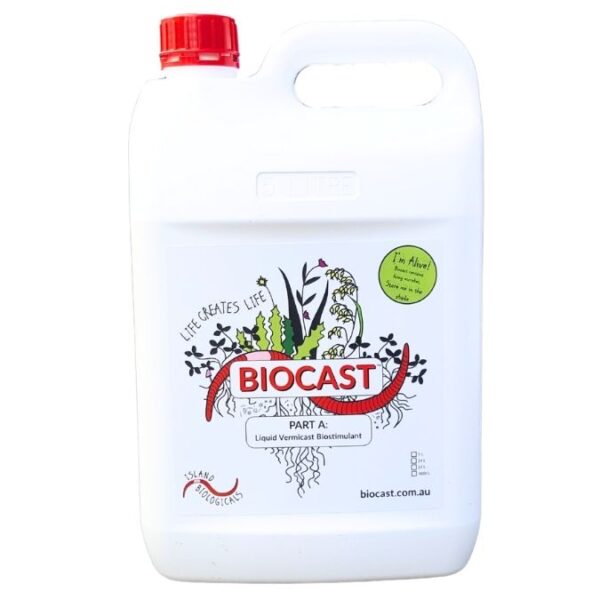
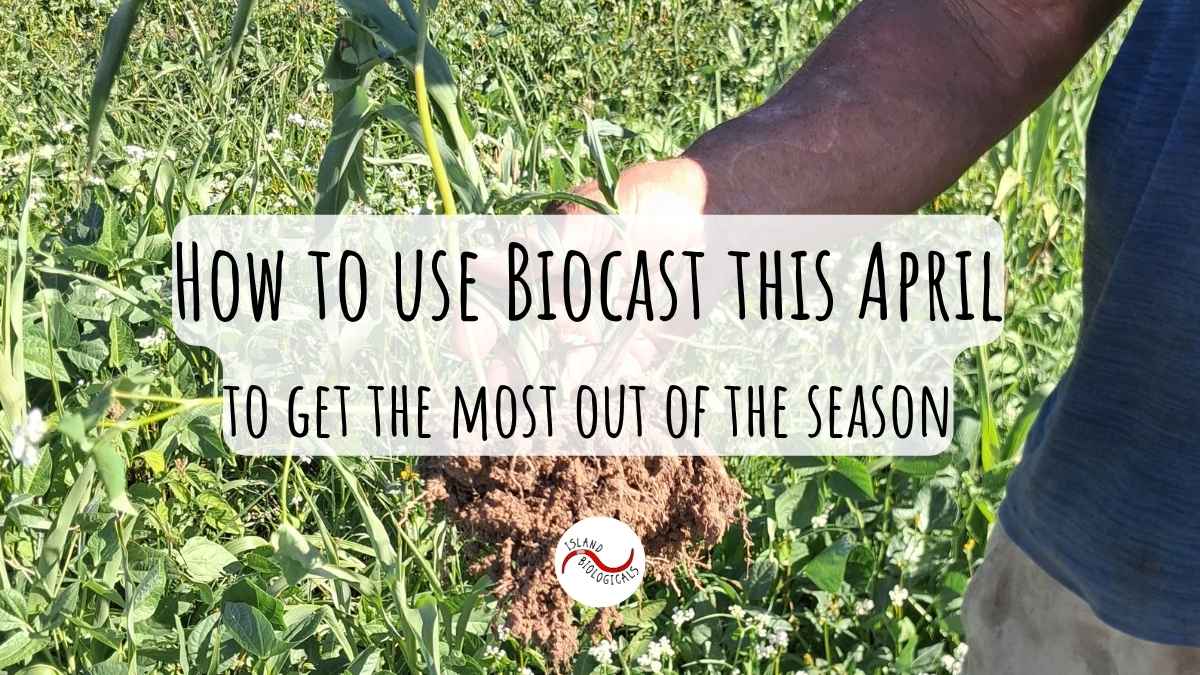
It is April, and an excellent time to be getting out in the paddock with the Biocast!
Here are our tips for using Biocast this season, but we also encourage you to have a play to see how your land responds with different applications, even if just in a small area. We have included some additional ideas of things you can play with at the end of each section, or you might have other ideas!
Biocast contains diverse living microbes as well as, enzymes, fulvic acid and signalling molecules (including phytohormones) that assist with soil health and fertility, and plant health and vigour.
Broadly speaking, Biocast will shine this season in helping you with abiotic stress resistance – read the dry forecast for much of Australia’s growing regions; and with enhancing nutrient availability, especially in light of fertiliser shortages! For those with a longer view, Biocast is one tool that will help you to build farm fertility, resilience to all sorts of biotic and abiotic stressors, and contribute to overall better ecological function, plant robustness and vigour.
Additionally, information out of Advancing Eco Agriculture (John Kempf) suggests that there are huge benefits to applying biology during autumn, including promoting humification (soil formation) and breaking disease cycles. Check out their info here: https://advancingecoag.com/article/7-reasons-nutrient-management-starts-in-the-fall/. We are keen to gain a better understanding of this in the Australian context with Biocast in the mix!
Biocast uses
Here is a summary of ways that you could use Biocast this season in different agricultural settings:
Perennial pastures:
If your pasture is still growing, apply Biocast as a foliar now to enhance soil and plant health. Application now could also improve your property’s resilience to forecast dry conditions. The recommended application rate is 5 L/ha. If you have pest and disease issues, or if you would like to utilise the fulvic acid component of Biocast (for drought resilience for example) then apply at higher rates.
For pastures in cooler areas that have already reached the end of the growing season, Biocast can be applied to assist with the slow cycling of organic matter into humus over the cold months. See the end of the article for a stubble digesting recipe!
Have a play: Potentially, the microbes in Biocast could be frost-protective when applied to the leaf surface. Did you know that bacteria is the most efficient frost nuclei? Theoretically, Biocast could support the ‘folisphere’s microbiome’ (microbes and environment on and within the leaf). We have not done experiments to determine at what concentration or timing would be most effective.
Have a play: Could Biocast break the cycle of pasture dieback? This disease is summer active. There’s a lot we don’t know about it, but potentially the biotic stress resilience and nutrition promoting properties of Biocast could have a significant impact and gently work away in the soil over winter. See also: Pasture Dieback: 60+ species to help you fill your feed gap and improve your soil.
Pasture cropping and annual winter forage sowing:
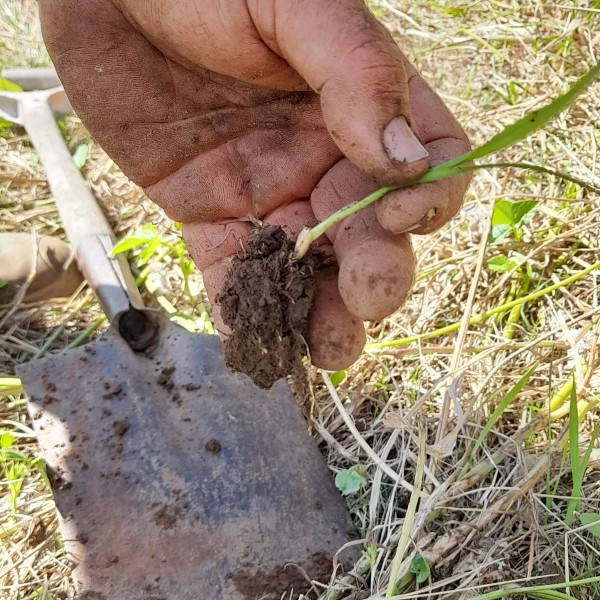
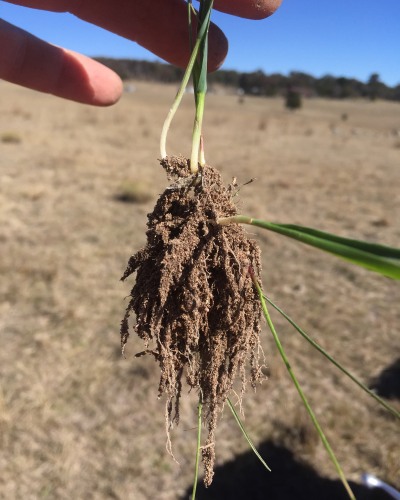
Apply Biocast as a seed primer to establish your seed into existing pasture without the need to kill it. We recommend slashing or heavily grazing a few days prior to sowing. Start with bare seed and follow the instructions on our ‘seed inoculation with Biocast’ page. Apply to seed at a rate of 5 L/tonne or more – the 5 L rate applies to very efficient application methods. The seed can be pre-wet then thoroughly dried for later sowing. Most users report excellent seed establishment in a variety of conditions, and more uniform timing of germination for mixed species sowing.
Cropping:
Seeding: Use Biocast as a seed primer to encourage strong establishment of winter crops, and early protection against dry conditions.
Post-harvest: Use Biocast as a seed primer for green fallow to build soil in the off-season post summer crop harvest, and enjoy a more robust summer season. You can also give our crop stubble digesting recipe a try (see below)!
To use Biocast as a seed bioprimer, start with bare seed and follow the instructions on our ‘seed inoculation with Biocast’ page. Apply to seed at a rate of 5 L/tonne or more – the 5 L rate applies to very efficient application methods. The seed can be pre-wet then thoroughly dried for later sowing. When you start with Biocast you do not need starter ferts or fungicides – the biology of the earthworm contained in Biocast provides this function and using them will suppress the biological benefits of Biocast. Commonly farmers notice that the effect of priming with Biocast lasts 2-3 months, after which you will need to monitor your crop and manage accordingly. Please call us to discuss ways that you can use Biocast throughout the season.
Have a play: incorporate a few extra seeds from different plant families to enhance your crop. These might be lower growing plants that do not compete with your main crop for light, or complementary plants that could be co-harvested for a double crop. Talk to your seed sorter about possibilities here.


Horticulture and viticulture:
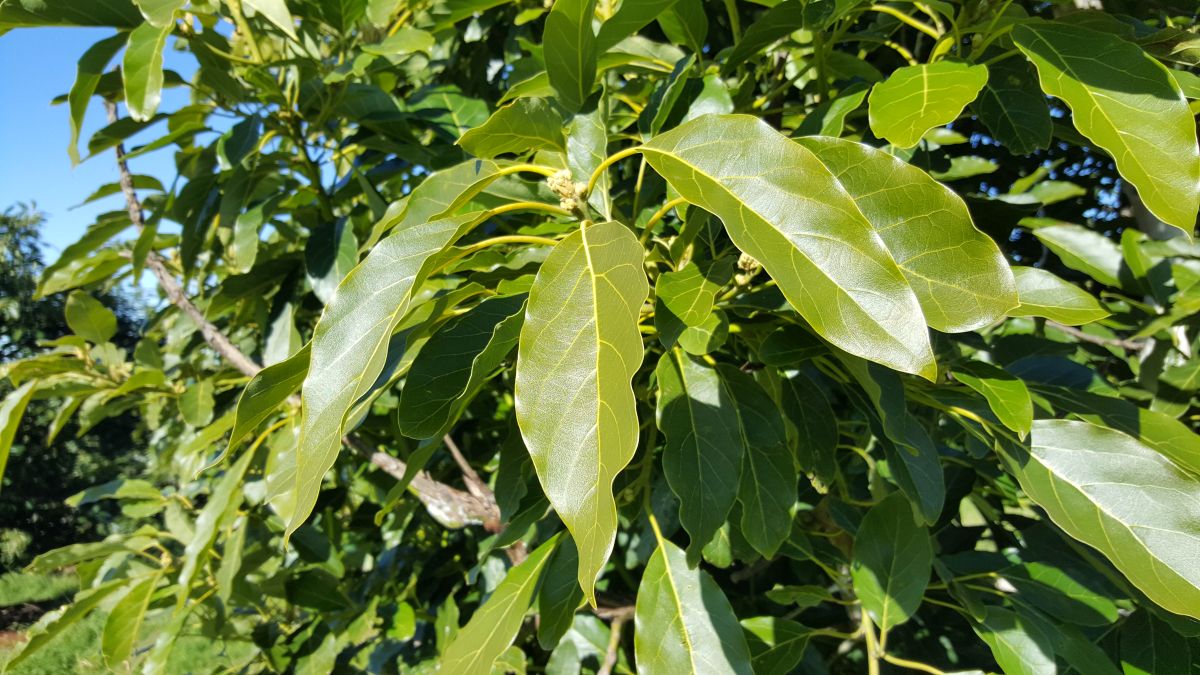
For perennial trees and shrubs, continue applying Biocast as a foliar as part of your maintenance regime, especially to help with fruit quality, disease resistance, and dry weather resilience. Biocast is compatible with most foliar nutrition supplements, including a natural fulvic acid component to assist with nutrient absorption. Always do a jar test before mixing new products. Please contact us to discuss rates and timing for your setting.
For deciduous trees and vines with green leaves still, apply Biocast as a foliar to build nutrition through winter for better fruit quality next season and bud development come spring. See also: ‘The Benefits of Post-Harvest Nutrients’ by Advancing Eco Agriculture: https://advancingecoag.com/article/the-benefits-of-post-harvest-nutrients/
Biocast applied to dead and dying leaves should assist with their breakdown and soil humification over winter. See the recipe below.
Apply Biocast as a foliar to interrow covers at a rate of 5 L/ha, or use it to dress seeds if planting annual covers. Your application rate will depend on how efficient your mixing is and on how you plan to put t he seed out, but starts at 5 L/t. Please contact us if you’d like to discuss rates. Instructions are here.
Have a play: apply a foliar before full leaf fall on deciduous plants to assist with breaking fungal and bacterial disease cycles. You will want to have some Biocast ready to put on as a foliar at the earliest sign of leaf growth after fruit set in the new season too, in combination with other plant-health supporting management practices relevant to your crop. We have been having a play with this at home with great success against leaf curl, sample size = 1 plant, we’re not prepared to make any claims yet.
Summary
In summary, where plants are still growing we recommend a foliar application of Biocast to maintain plant health and vigour, and to help with soil humification processes coming into the cooler months. For those planting, Biocast is excellent as a bioprimer to assist with seed establishment and soil building. Biocast can also be used to help break down plant residue and encourage healthy cycling processes. This season the particular areas where Biocast will shine are in:
- Facilitating nutrient delivery to plants biologically, at a time when fertilisers are hard to come across.
- Providing resilience to plants and soils for the forecasted dry season ahead. Biocast is not a substitute for water, but it should help your plants to survive better. We recommend also utilising mixed families plantings.
- Helping with soil building and recovery after what has been a challenging year for many.
As ever, Biocast is best used as one tool in a mix of management practices that help to build your soil and
How are you going to use Biocast this season?
Stubble digesting recipe
Provided to us courtesy of Jason Simmons of The Overseer Saddlery, a biological farmer and Biocast supplier near Armidale, NSW.
5 parts Biocast
5 parts molasses
5 parts fish hydrolysate
Dilute with water to spray the mix at a rate of 15 L/ha.
References
Ramesh, B. et al. (2025). Vermicast, Vermiwash: A Suitable Alternative to Chemical Fertilizers. In: Aransiola, S.A., Maddela, N.R. (eds) Vermitechnology: Economic, Environmental and Agricultural Sustainability. Springer, Cham. https://doi.org/10.1007/978-3-031-96212-7_14
Rehman, S.u.; De Castro, F.; Aprile, A.; Benedetti, M.; Fanizzi, F.P. (2023) Vermicompost: Enhancing Plant Growth and Combating Abiotic and Biotic Stress. Agronomy, 13, 1134. https://doi.org/10.3390/agronomy13041134
Subhra Chakraborti, Kuntal Bera, Sanjoy Sadhukhan, Puspendu Dutta, (2022). Bio-priming of seeds: Plant stress management and its underlying cellular, biochemical and molecular mechanisms, Plant Stress, Volume 3, 100052,
https://doi.org/10.1016/j.stress.2021.100052
Vambe, M. et al. (2023). Potential role of vermicompost and its extracts in alleviating climatic impacts on crop production,
Journal of Agriculture and Food Research, Volume 12, 100585, https://doi.org/10.1016/j.jafr.2023.100585
Verma, S. et al. (2018). Significance of vermiwash on crop production: A review. Journal of Pharmacognosy and Phytochemistry. https://www.academia.edu/68223180/Significance_of_vermiwash_on_crop_production_A_review